Key Takeaways
- Polyaspartic is UV stable. It won’t yellow in the Georgia sun the way epoxy does.
- Hot tire pickup is an epoxy problem. Polyaspartic stays flexible under heat and resists it.
- The best professional system uses both. Epoxy as the base coat, polyaspartic as the finish coat.
- Surface prep matters more than the coating itself. Diamond grinding is the only method that creates a bond built to last.
- A professionally installed polyaspartic system lasts 15 to 20 years. Most DIY epoxy kits fail within two.
Most homeowners start their search by typing “epoxy garage floor” into Google. Makes sense. Epoxy’s been the go-to term for decades. But if a contractor shows up and only talks about epoxy, that’s worth paying attention to — because the industry has largely moved on.
Polyaspartic floor coating is what most professional installers use as the finish coat today. It’s technically a type of aliphatic polyurea, first developed in the early 1990s by Bayer MaterialScience in Germany. The chemistry was originally engineered for corrosion protection on steel structures before finding its way into residential flooring — and for good reason. It cures faster, holds up better to UV exposure, and stays flexible enough to resist chipping when concrete shifts.
Epoxy is still used. Just not the same way.
Why Epoxy Still Dominates the Search Results
Here’s the thing — epoxy isn’t a bad product. It’s been coating concrete floors for over 30 years. It bonds well, it’s hard, and it handles chemical spills without flinching. The reason it still shows up everywhere in search results is simple: most homeowners know the word.
What they don’t know is that the product landscape has shifted. When a homeowner calls around and asks for “an epoxy floor,” they might get exactly that — an epoxy-only system that looks great on day one and starts yellowing by year two.
That’s not a scare tactic. That’s chemistry. Epoxy uses aromatic isocyanates in its formulation, which degrade when exposed to UV light. The result is a floor that fades, yellows, and loses its gloss over time — especially in a south-facing garage with the door open half the day.
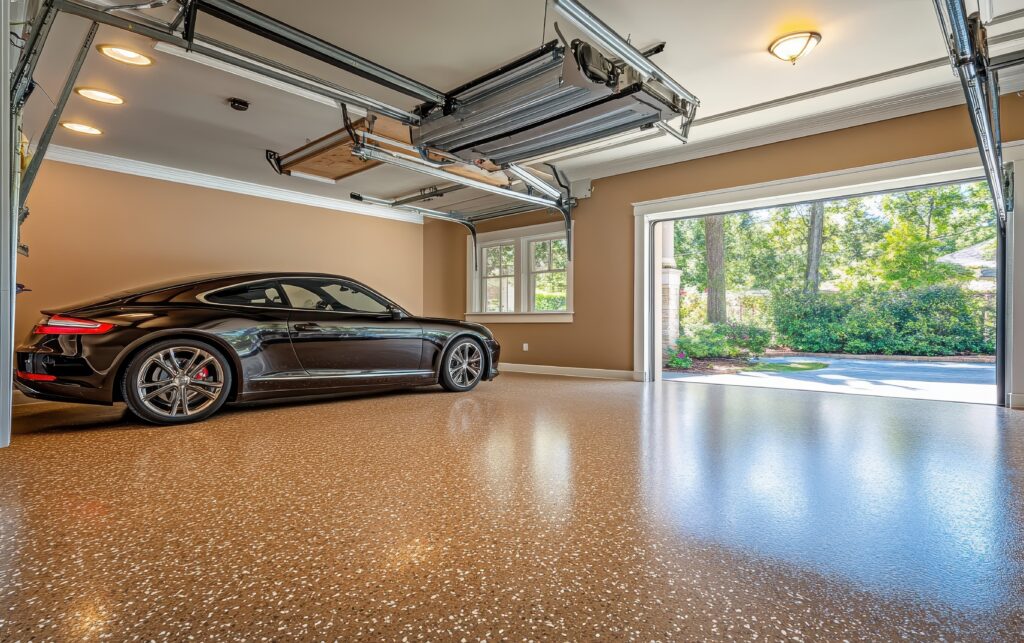
spacious Georgia garage offering ample storage options
What Georgia’s Climate Does to an Epoxy-Only Floor
This is where geography actually matters. Atlanta summers are brutal. High heat, intense sun, and humidity that doesn’t let up for months. A standard epoxy floor in a Georgia garage faces two problems that don’t show up as much in cooler climates.
First, hot tire pickup. When a car’s been sitting in the summer sun, the tires get hot. Park that car on an epoxy floor and that heat softens the coating just enough to bond slightly to the rubber. When the car moves, it pulls the coating with it — leaving marks or outright delaminating the floor. It looks bad and there’s no easy fix.
Second, UV yellowing. South Atlanta gets significant direct sun exposure through open garage doors and windows. Epoxy floors that see regular UV contact start turning yellow within a year or two, sometimes sooner.
Polyaspartic topcoats don’t have either of these problems. The aliphatic chemistry is UV stable by nature — it won’t yellow regardless of sun exposure. And it stays flexible enough under heat that hot tires don’t pull it up. That’s not a marketing claim — it’s documented in published research on polyaspartic ester chemistry and verified by LATICRETE’s polyaspartic technical documentation, one of the larger licensed manufacturers in the space.
Epoxy vs. Polyaspartic: Side by Side
If you’re trying to decide between the two — or just want to understand what a contractor is telling you — this comparison covers the practical differences.
Epoxy
- UV Stability: Yellows over time with sun exposure
- Cure Time: 1–3 days to walk on; up to a month to fully cure
- Hot Tire Resistance: Prone to pickup and delamination
- Flexibility: Rigid — can crack with concrete movement
- Upfront Cost: Lower
- Lifespan: Shorter without UV protection
- Best Used As: Base coat (adhesion layer)
Polyaspartic
- UV Stability: UV stable — holds color and gloss
- Cure Time: Foot traffic in hours; vehicles in ~24 hours
- Hot Tire Resistance: Stays flexible; resists tire pull
- Flexibility: Flexible — moves with the slab
- Upfront Cost: Higher
- Lifespan: Longer in Georgia conditions
- Best Used As: Finish coat (protection layer)
The takeaway isn’t that epoxy is bad. It’s that each product has a role. Epoxy does its best work as a base coat, where its self-leveling properties and adhesion strength shine. Polyaspartic does its best work on top, where UV exposure and daily wear are the real threats.
The Two-Stage System Most Professionals Use
So which one wins — epoxy or polyaspartic? The honest answer is that it’s not really an either/or decision for a professional installation.
The system that produces the most durable, longest-lasting result combines both. An epoxy basecoat goes down first. Epoxy has excellent adhesion to properly prepared concrete, good thickness, and self-leveling properties that fill minor surface irregularities. It does the heavy lifting as a foundation layer.
Then a polyaspartic topcoat goes on top. That’s where the UV stability, scratch resistance, and flexibility live. The epoxy handles the structure. The polyaspartic protects the surface.
This is the two-stage approach that serious flooring contractors use. One-coat systems that skip the epoxy base in exchange for a faster job can work fine — but the best results consistently come from a basecoat-and-topcoat system where each layer does what it does best.
Simiron, the coating brand used by Custom Garage Floors, is built around this approach. It’s the same product line used by some of the highest-rated concrete coating companies in the Atlanta area. If you want to see how it fits into a full garage flooring installation, the garage flooring page walks through the process.
Cure Time, Cost, and What to Actually Expect
One of the most practical differences is how long the job takes.
Epoxy-only systems can take two to three days to cure fully. That means the garage is out of service for most of the week. Polyaspartic topcoats cure much faster — foot traffic is often possible within a few hours, and most vehicles can return within 24 hours.
On cost: polyaspartic systems run higher than epoxy-only installs. That’s real. But the comparison isn’t just upfront price — it’s how long the floor holds up before it needs to be redone. An epoxy floor that starts failing in two to three years and a polyaspartic floor that looks the same in year eight aren’t actually the same value, even if one costs more at the start.
According to Garage Monkey’s analysis of floor coating durability, the key distinction isn’t hardness — it’s toughness. Some epoxies technically score higher on hardness scales, but polyaspartic wins on flexibility and impact resistance, which are what actually matter when concrete expands and contracts with Georgia’s temperature swings.
The Part Nobody Talks About Enough
None of this matters if the surface isn’t prepared correctly.
That’s not an exaggeration. The coating — whether it’s epoxy, polyaspartic, or a combination — is only as good as what it’s bonded to. A floor that’s been chemically etched but not mechanically ground will peel. Sometimes in six months. Sometimes within a year. The coating lifts off the concrete surface because the bond was never deep enough to hold.
Industrial diamond grinding is the fix. It opens the concrete to a CSP 2–3 profile — the surface roughness that epoxy and polyaspartic systems require for proper mechanical adhesion. The technical standards behind this are available at the International Concrete Repair Institute, which developed the CSP scale used by coating manufacturers to set warranty requirements. Acid etching, by comparison, produces at best a CSP 1 — not enough for a coating system that needs to hold up to vehicles, heat, and daily use.
Stronghold Floors, a company with 20 years in the garage coating business, notes that surface prep failures — not material failures — are the leading cause of garage floor coating problems.
Home Depot kits don’t come with a diamond grinder. Most budget installs skip the grinding because it takes equipment and time. That’s the actual difference between a floor that lasts a decade and one that’s peeling by next summer.
Custom Garage Floors grinds every floor before coating. It’s not optional. The same principle applies whether the project is a garage, a concrete patio, or a basement floor — the prep sets up everything that comes after it.
Frequently Asked Questions
Does polyaspartic garage floor coating yellow in the Georgia sun?
No. Polyaspartic uses aliphatic chemistry, which is UV stable by design. The color and gloss hold up even in a south-facing garage with the door open all day. Standard epoxy is a different story — aromatic epoxies degrade under UV and typically start yellowing within one to two years in Georgia conditions.
How long does a polyaspartic garage floor last?
A professionally installed polyaspartic system lasts 15 to 20 years in a residential garage with normal use and basic maintenance. That estimate assumes proper surface prep — diamond grinding to the correct profile — and a quality coating system. Floors that were etched instead of ground, or installed with lower-grade materials, fall well short of that range.
Will hot tires damage a polyaspartic floor in the summer?
No. Hot tire pickup is an epoxy problem, not a polyaspartic one. The issue happens when rigid epoxy softens slightly under heat and bonds to warm rubber. Polyaspartic stays flexible under those conditions, so the coating doesn’t grip the tire when the car pulls out. It’s one of the specific reasons polyaspartic makes more sense as a finish coat in Georgia’s climate.
What’s the difference between polyaspartic and polyurea?
Polyaspartic is a type of aliphatic polyurea — so the terms are related but not interchangeable. Standard polyurea cures extremely fast, sometimes within minutes, which makes application difficult and increases the risk of adhesion problems. Polyaspartic is formulated with a slower reaction time that gives installers a workable window while still curing faster than epoxy. It also has better UV stability than polyurea.
Can I coat my garage floor myself with a kit from Home Depot?
You can, but the results are unlikely to last. DIY kits typically use thin epoxy paint rather than a professional coating system, and they rely on acid etching for surface prep. Acid etching produces a CSP 1 surface profile — not enough for a coating that needs to hold up to vehicles and heat. Most DIY floors start peeling within a year or two. The grinding equipment required for proper prep isn’t something that comes in a kit.
How long will my garage be out of service after coating?
With a polyaspartic topcoat system, foot traffic is usually safe within a few hours of the final coat. Most vehicles can return within 24 hours. Epoxy-only systems take longer — often two to three days before driving on them, with full cure taking up to a month. For a working garage, the turnaround difference is a real practical advantage.
Which One Is Right for a Garage in South Atlanta
For a residential garage in the south Atlanta area — Peachtree City, Newnan, Fayetteville, McDonough, or anywhere in the corridor — the combination system makes the most sense. Epoxy base, polyaspartic topcoat, Simiron-grade materials, and diamond grinding underneath all of it.
That’s the system that holds up to Georgia summers, stays looking clean, and doesn’t need to be redone in two years. More on the polyaspartic floor coating options available, including color and flake selections, is on the service page.
Epoxy by itself is fine for plenty of applications. But for a garage floor that sees heat, UV, and daily vehicle traffic in a warm southern climate, polyaspartic as the finish coat isn’t an upgrade — it’s the right call.